2026 Interior Design Trends: Warm Minimalism, Curves and Colour After Greige
Last updated: 16 October 2026
Researched and drafted with AI assistance; reviewed, fact-checked and approved by Thomas Lovas Lokoy. Editorial policy
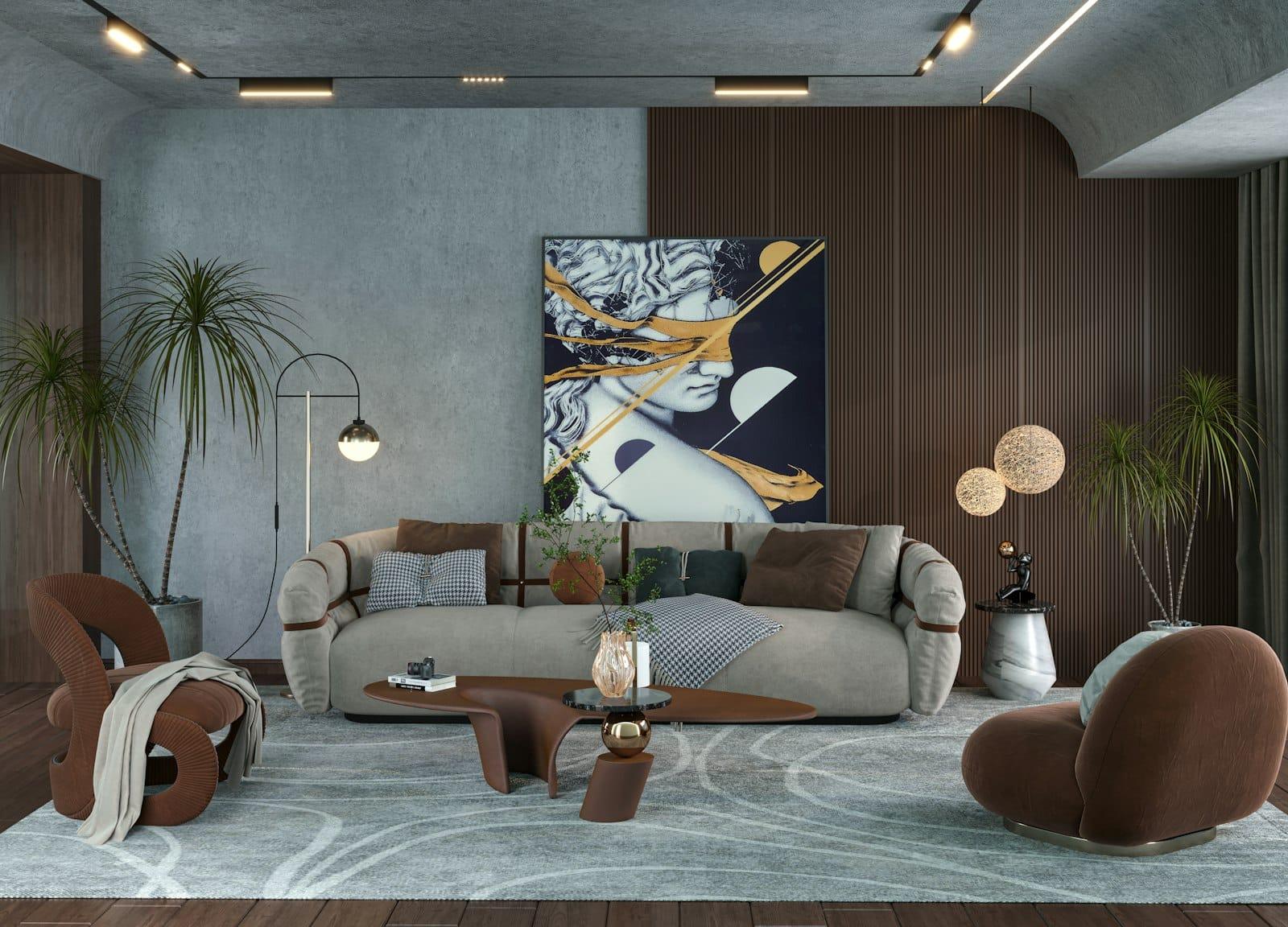
The 2026 interior design trends worth acting on are warm minimalism (fewer pieces, more texture), curved and low-slung furniture, colour that has moved away from flat grey towards earthy browns, plums, greens and blues, kitchens that look like furnished rooms rather than walls of cabinets, and a stronger interest in where materials come from. The paint makers' own 2026 colours of the year confirm the move to depth, with one caveat this article takes seriously: greige is not dead, because two of the biggest names chose a white and a khaki neutral. Below: what each trend means in a real room, the colour picks in one table, and how to adopt the trends without dating your home.
Mercifully, the age of the clinical lobby-lounge is passing, making way for spaces that acknowledge someone actually lives in them.
The decade began with a collective obsession with the non-colour. Homes were surrendered to greige, that safe purgatory between beige and grey chosen with resale value in mind, by people who saw their homes as assets first and sanctuaries second. In 2026 the pendulum is swinging back, and the direction is clear even if the speed is not.
What the paint makers chose for 2026
The most checkable signal of where interiors are heading is what the big paint and colour companies chose as their colours of the year. ArchDaily collected the 2026 picks in January:
| Company | 2026 colour | How it is described |
|---|---|---|
| Pantone | Cloud Dancer (PANTONE 11-4201) | A soft white |
| Benjamin Moore | Silhouette (AF-655) | Burnt umber with charcoal notes, a dark tone between warm and cool |
| Graham & Brown | Divine Damson | A deep damson inspired by ripe damson and fig |
| C2 Paint | Epernay (#639) | A soft ochre with muted mineral undertones |
| Behr | Hidden Gem | A muted, smoky jade |
| AkzoNobel | Rhythm of Blues trio: Mellow Flow, Slow Swing, Free Groove | A light blue, a darker blue and a more saturated blue |
| Valspar | Warm Eucalyptus (8004-28F) | A muted green with warm undertones |
| Sherwin-Williams | Universal Khaki (SW 6150) | A mid-tone neutral with warm, earthy undertones |
Read the table as a whole and the story is more interesting than "greige is over". Most of the picks are deeper and warmer than the cool greys of the last decade: an umber brown, a damson, an ochre, greens, blues. But Pantone chose a white and Sherwin-Williams a warm khaki neutral. The honest summary is that the cool, flat grey-beige is losing ground to warmer neutrals and saturated earth tones, and that a warm off-white is still the safest canvas in the industry's eyes.
Colour after greige: depth, warmth and the colour drench
The problem with cool greige was never its neutrality; it was its indifference to light. In northern latitudes, a cool grey room on a November afternoon looks like the inside of a damp cardboard box. The colours that are replacing it have movement: burnt oranges, muddy greens, a velvety crimson that borders on brown.
The technique gaining ground is the colour drench: one colour taken across walls, skirting boards, cornices and sometimes the ceiling, rather than a timid accent wall. A dark room does not necessarily feel smaller; it often feels more private, and the edges of the room recede. If you want to try it, the safe way in is a small room you use in the evening (a study, a snug, a cloakroom), in one of the earthier picks above rather than a pure black.
The deeper point is about materials. Complex, pigmented colours expose the quality of what they are painted on. Flat-pack furniture in "oak effect" or "slate grey" looks fine against greige and cheap against umber. Moving to depth tends to push people towards real plaster, real wood and real stone, which is why this trend lasts longer than most.
The curve: softening the edges
For decades, modern interiors were synonymous with the right angle: the Bauhaus filtered through a property developer's spreadsheet. In 2026, the home is embracing the arc.
The clearest evidence is in seating. Two 1970s designs that went back into production show how far the appetite for soft, low, modular shapes has come: Pierre Paulin's Pacha, designed in 1975 for the French company Mobilier International and now made by Gubi, and Mario Bellini's Camaleonda, the tufted modular sofa B&B Italia reissued in 2020, half a century after it first appeared, with a recyclable internal structure. Both are low-slung and free of sharp corners, and both encourage a slouching, informal comfort the rigid sofas of the 2010s did not.
Architecturally, the same idea shows up as curved niches and rounded doorways, made by thickening walls. If you are renovating this year, find a contractor who does not wince at the mention of a radius. The arch is no longer a Spanish-revival trope; it is how a hard-edged plan is made to feel softer.
The materials pairing is heavy and honest: poured concrete, dark walnut and unpolished travertine, worked into shapes that feel grown rather than machined. The rejection of the slimline in favour of the substantial is one of the clearest shifts of the year.
Warm minimalism: knowing when to stop
Minimalism has a reputation for being cold: white-walled galleries where one is afraid to sneeze. Warm minimalism is the antidote. It keeps the "less, but better" discipline and swaps empty surfaces for texture.
The late Virgil Abloh described a personal rule that an existing object needs to be altered by only about three per cent to become something new. In a warm-minimalist room, that small, decisive change is usually texture. Instead of a flat white wall, consider tadelakt, the traditional Moroccan lime plaster used for centuries in hammams and bathrooms: it is applied wet, burnished with stones and sealed with black soap, which reacts with the lime to make the surface water-repellent, and it can form seamless curves. It is labour-intensive and needs periodic re-sealing, which is part of its character.
The furniture choices are equally deliberate. A warm-minimalist room might hold only four pieces, but one will be an antique with a history and another something made by hand. The goal is a room that looks assembled over decades, even if it was finished last month.
Lighting follows suit. The grid of recessed downlights is out of favour, because nothing flattens a room like a ceiling of small, bright points beaming onto the tops of heads. The direction is lower, warmer and more sculptural: paper lanterns in the spirit of Isamu Noguchi's Akari, and table and floor lamps that are objects in their own right. A useful test: if your lighting does not look interesting when it is switched off, it is not doing enough. For a fuller plan, see the four-layer lighting scheme in designing rooms you keep for thirty years.
The kitchen as a furnished room
The show kitchen, that pristine white-marble expanse where no one ever chopped an onion, is giving way to the kitchen as the social centre of the home. The aesthetic shift is towards less-fitted kitchens: fewer walls of identical cabinets, more freestanding pieces such as a worktable-style island, open shelving and a dresser.
Materials are moving away from the most delicate marbles (Carrara etches if you look at a lemon) towards more forgiving, more characterful stones and towards live finishes such as unlacquered brass and copper that patina over time. A scratch on a brass worktop is not a defect; it is a record of a dinner party.
Appliances are increasingly hidden behind timber panels so that a kitchen with professional-grade kit still reads as a room. The most ambitious move, where the plan allows, is the back kitchen or scullery: the main kitchen stays for the final assembly and the conversation, while washing up and vegetable prep happen in a small room behind a door. If you are hosting regularly, our four-hour plan for dinner for six shows why a calm, clean front kitchen matters.
Provenance: beyond the buzzword
Sustainability is no longer a bullet point on a product page. Buyers want to know which forest their oak came from and whether the weaver of their rug was paid fairly. The most convincing version of the trend is hyper-local making. In England, Sebastian Cox's workshop is a good example: the company harvests coppiced chestnut and hazel from its own Kent woodland under a management plan aimed at biodiversity, and works it into furniture.
New materials are arriving too. Mycelium, the root structure of fungi, has crossed from lab to luxury: in 2022 Stella McCartney released the Frayme Mylo, presented as the first luxury bag made from mycelium-based Mylo, in a limited run of 100. Expect the same material story to keep moving into objects for the home.
And vintage is no longer only for mid-century specialists. Interiors in 2026 happily mix centuries: a contemporary chair beside an eighteenth-century commode reads as a dialogue, not chaos, and it signals a home assembled by a person rather than bought from one showroom floor.
How to use the 2026 trends without dating your room
Trends are useful only if they stay in the right layer. The rule we use is to keep fashion in the soft, cheap-to-change layer and out of the floor, walls and joinery.
| Trend | Safe way to adopt it | Risky way to adopt it |
|---|---|---|
| Earthy, deeper colour | A drenched snug or study; cushions, a rug, a lamp | A trend colour on kitchen cabinets or tiles |
| Curves | One curved sofa or a round table | Rebuilding every doorway as an arch |
| Warm minimalism | Fewer, better pieces; one textured wall | A themed room built around a single look |
| Unfitted kitchen | A freestanding island or dresser in an existing kitchen | A full kitchen rip-out for a look |
| Provenance | Buying the next piece from a maker who names the wood | Replacing sound furniture to follow the story |
You do not need a renovation to start. A single well-chosen object, a lamp with real weight, a textured piece on the wall, a rug that changes how the floor sounds, carries the mood into a room long before the plasterer arrives. Buy one thing properly rather than six things provisionally, and see our luxury home decor guide for the pieces worth building around.
Related reading: a short history of Scandinavian design, the case for a dedicated library room and commissioning bespoke furniture worth the wait.
Frequently asked questions
What are the biggest interior design trends for 2026?
Warm minimalism (fewer pieces, more texture), curved and low-slung furniture, deeper and warmer colour in place of cool greige, less-fitted kitchens that look like furnished rooms, and more attention to where materials come from.
Is greige out of style in 2026?
Cool, flat grey-beige is losing ground, but neutrals are not finished. Most 2026 colours of the year are deeper and warmer (Benjamin Moore's Silhouette, Graham & Brown's Divine Damson), yet Pantone chose a soft white, Cloud Dancer, and Sherwin-Williams a warm khaki neutral, Universal Khaki.
What is warm minimalism?
A version of minimalism that keeps the "less, but better" discipline but replaces bare, cold surfaces with texture: lime plasters such as tadelakt, natural wood and stone, soft low lighting and a small number of pieces with character.
How do I follow trends without dating my home?
Keep trends in the layer that is cheap to change (cushions, rugs, lamps, paint in a small room, one statement piece) and keep the floor, walls, kitchen and joinery in materials and colours that will last.
Sources
- archdaily.com/1037721/2026-color-of-the-year-selections-highlight-tonal-depth…
- pantone.com/color-of-the-year/2026
- galeriemagazine.com/bb-italia-mario-bellini-camaleonda-sofa
- sebastiancox.co.uk/faqs
- fashionunited.uk/news/fashion/stella-mccartney-to-launch-first-commercial-lux…
- en.wikipedia.org/wiki/Tadelakt
Continue Reading
Continue in this collection

Found this useful? Explore more in the Journal.
BACK TO JOURNAL